

UX Certification
Get hands-on practice in all the key areas of UX and prepare for the BCS Foundation Certificate.

There’s no getting away from the fact that some aspects of usability can appear fairly tedious. At a recent conference I attended I decided to observe members of the audience and measure the HTFDR (head-to-floor distance reduction). When the topic of usability standards came up, my estimate is that the HTFDR dropped from 135cm to 121cm, only to bounce back to normal when the speaker uttered the magic words: "And in conclusion…"
It’s a difficult job to make standards interesting, but it is worth considering why we need a standard for web usability.
Most standards activity relevant to the web has emerged from the W3C but they have little to say about usability. Enter the International Standards Organisation (ISO). ISO are engaged in developing a new standard titled ISO/ AWI 23973 "Software ergonomics for World Wide Web user interfaces". ISO has been developing ergonomics standards for over 20 years and one of their sub-committees (SC 4) is responsible for standards in the field of human system interaction. I attend one of SC 4’s working groups (WG 5) as the UK expert on behalf of the British Standards Institute.
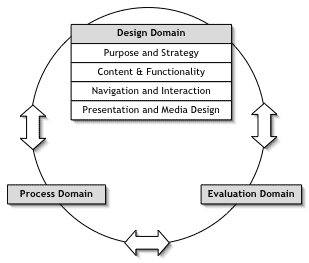
This new web usability standard — or more technically, "work item" as it hasn’t been approved yet — is based around a reference model that distinguishes the three domains within which design work is carried out (see the figure below.
The ISO 23973 Reference Model
The emerging standard addresses the design domain only, so this isn’t the place to go if you are interested in usability evaluation or design process (although it does contain a handy list of references to these other areas). Where it will help is when you are involved in the nitty-gritty of design decisions and need some authoritative guidance.
The standard contains detailed guidance in four main areas:
Given the current emphasis on disability issues, you might be surprised to find that the emerging standard does not have much to say about accessibility. But this is because ISO is developing another standard specifically on this issue (ISO/ AWI 16071 "Ergonomics of human-system interaction — Guidance on software accessibility").
The document is set to become a Committee Draft or CD in a few months. At that point, it is open to comment by national standards bodies.
Note added 7th July 2004: The international community have recently approved the Committee Draft and so the document has now progressed to the next stage of processing: a "Draft International Standard".
Note added 3rd July 2008: This is now an International Standard, published as ISO 9241 part 151.

Dr. David Travis (@userfocus) has been carrying out ethnographic field research and running product usability tests since 1989. He has published three books on user experience including Think Like a UX Researcher. If you like his articles, you might enjoy his free online user experience course.

Gain hands-on practice in all the key areas of UX while you prepare for the BCS Foundation Certificate in User Experience. More details

ISO 9241 is an influential usability standard. Read our quick guide. ISO 9241.
Our most recent videos
Our most recent articles
Let us help you create great customer experiences.
We run regular training courses in usability and UX.
Join our community of UX professionals who get their user experience training from Userfocus. See our curriculum.
copyright © Userfocus 2021.
Dr. David Travis (@userfocus) has been carrying out ethnographic field research and running product usability tests since 1989. He has published three books on user experience including Think Like a UX Researcher.
Get hands-on practice in all the key areas of UX and prepare for the BCS Foundation Certificate.
We can tailor our user research and design courses to address the specific issues facing your development team.
Users don't always know what they want and their opinions can be unreliable — so we help you get behind your users' behaviour.