Latest videos
- User research when social distancing. How can I do user research when I’m social distancing? Here are 30 ideas.
- How to create bulletproof survey questions. I answer the question, "My boss has asked me to do a survey with our customers. Any tips on writing good survey questions?"
- Can you re-use usability test participants? I answer the question, "I'm iterating my design for the 'Gift Giver' app as part of the course. Do I have to test this iteration with completely different users to those that I tested for the initial design?"
- Why you don't need user representatives. I answer the question, "What would you call someone who is made a user representative in a project, e.g. user lead/advocate/champion?"
Filter articles by topic
Bright Ideas for User Experience Researchers
If you're a user experience researcher, start here. This eBook contains 91 pages of real-world help on topics like field visits, usability expert reviews and personas. Free download, no sign up required.
Bright Ideas for User Experience Designers
If you're a user experience designer, start here. This eBook contains 100 pages of real-world help on everything from prototyping to writing user support. Free download, no sign up required.
Bright Ideas for User Experience Managers
If you're a user experience manager (or just like to take a strategic view), start here. This eBook contains 78 pages of real-world help on subjects like recruiting UX staff, selling usability and institutionalising usability in your organisation. Free download, no sign up required.
The Fable of the User-Centered Designer
Follow a young man's journey as he discovers the three secrets of user-centred design. It's a small book that has big results. Free download, no sign up required.

Usability Test Moderation: The Comic
If you've been tasked with running a usability test, then you'll love this instructional guide. Aimed at people about to moderate their first usability test, this graphic instruction guide covers the essential techniques you'll need to moderate a usability test. Free download, no sign up required.
ISO 9241 for Beginners
ISO 9241 is widely cited by user experience experts who would be hard pushed to name any other standard — but all most usability professionals know about the standard is its name. This eBook describes each of the published parts of ISO 9241 in detail. Free download, no sign up required.
Usability Test Plan Toolkit
This eBook contains all you need to make sure that you're fully prepared for your next usability test. The document includes easy to customise usability test forms, such as screeners, a discussion guide, questionnaires and data logging sheets. Free download, no sign up required.
Morae for Usability Practitioners
Targeted at both new and experienced users of Morae, Morae for Usability Practitioners is a step-by-step guide to using Morae to plan, execute and analyse usability tests. Packed with insider tips and expert advice, this guide will help you use Morae to its full potential. Free download, no sign up required.
User Experience Research articles & resources
Bright Ideas for User Experience Researchers
If you're a user experience researcher, start here. This eBook contains 91 pages of real-world help on topics like field visits, usability expert reviews and personas.
Usability task scenarios: The beating heart of a usability test

2 December, 2019 - Usability tests are unique. We ask people to do real tasks with the system and watch. As the person completes the task, we watch their behaviour and listen to their stream-of-consciousness narrative. But what makes a good usability task scenario?
Common traps in user needs research and how to avoid them

4 Nov, 2019 - Whether you call it a field visit, a contextual inquiry or a customer discovery interview, the goal of early stage research is the same: to uncover users' needs. Here are 5 mistakes I've seen crop up time and again in this kind of research.
Transitioning from academic research to UX research

7 Oct, 2019 - Doing UX research in a university is very different to doing UX research in a business setting. If you're an academic making the leap, what are the main differences you need to keep in mind?
The minimalist field researcher: What's in my bag?
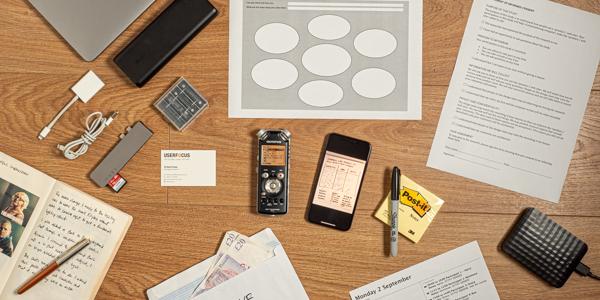
2 September, 2019 - When carried out in a lab, user experience research is gear heavy. You need technology to record audio, video and the screen of the device under test. In contrast, when carried out in the field, user experience research is more lightweight. Even so, there are a few non-obvious items of kit that I find essential on a field visit.
The future of UX research is automated, and that's a problem
5 August, 2019 - If you compare the UX research methods we use today with the methods we used 16 years ago, something interesting emerges. We see that UX research is becoming increasingly remote and increasingly unmoderated. In other words, we're moving to a world where UX research is becoming automated. We can learn a lot from automated research. But it comes at the price of understanding our users.
Repeat after me: Preference testing is not A/B Testing
5 Mar, 2019 - Researchers sometimes ask participants which of two alternative designs they prefer. The data from these studies comprise opinions that have little predictive value. In contrast, multivariate A/B testing involves target users doing real tasks. The data from these studies comprise behavioural observations that predict real-world behaviour.
10 diagrams to help you think straight about UX Research
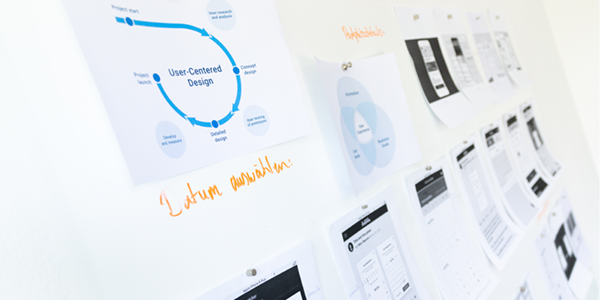
3 Dec, 2018 - Some of the problems we work on as UX researchers are simple and are easily solved by getting users in front of our product. But other problems can be complex and it's hard to know how to start solving them. In situations like that, a simple 2x2 diagram can cut through the "what ifs", the "how abouts" and the edge cases and provide a simple way of looking at the problem. Here are 10 examples of 2x2 diagrams to simplify UX research discussions.
See different

5 Nov, 2018 - Being able to see things through the eyes of someone else is one of the most important abilities a designer can have. But it's also very difficult for most of us to do. Could a rather dramatic break with convention put designers into the shoes of the people they design for?
Storytelling in UX research

1 Oct, 2018 - UX researchers are storytellers who have devised tools like personas and user journey maps to tell the story of their research. Focusing on the story, rather than the tool, is a powerful way to become more effective.
Using the cognitive interview to improve your survey questions

3 Sept, 2018 - In an ideal survey, each respondent interprets the question in the way we intended. But in reality, survey questions are misunderstood. Participants may find the answers hard to recall, difficult to estimate, and struggle to map their answer to the choices we provide. The cognitive interview provides a useful method to evaluate survey questions and remove these problems.
Anatomy of a user research consent form
2 July, 2018 - We've always treated the informed consent process seriously and we have always gained explicit consent from people that take part in our field visits and usability tests. Although I think we do a good job of gaining consent, the advent of GDPR gave us an opportunity to review what we do. We were interested if there was a way we could improve our practice.
How to spend your first month in a UX research role (and stay friends with your new work colleagues)

4 June, 2018 - When you start a new job as a user researcher, you need to both charm your work colleagues (so they take action on your future research findings) and challenge them (so they become more user centred). How can you best achieve this in your first 4 weeks in a new job?
Why you don't need a representative sample in your user research

3 April, 2018 - Engaging a representative sample of participants in user research sounds like a good idea but it is flawed. It requires lots of participants, does not work in an agile development environment, stifles innovation and reduces your chances of finding problems in small sample usability tests. When combined with iterative design, theoretical sampling (where theory and data collection move hand in hand) provides a practical solution.
What is design ethnography?

5 February, 2018 - A common mistake made by novice researchers is to ask users what they want from a new product or service. Although this seems like the correct way to do user research, in most cases users don't know, don't care or can't articulate what they need. It is the design team's job to establish the underlying problem, identify the best solution and then validate that their solution works. Design ethnography is the first step on that journey.
The User Researcher's Field Guide to Psychology
8 January, 2018 - When planning user research studies, there are four fundamental principles from psychology that user researchers must know. These are: your users do not think like you think; your users don't have good insight into the reasons for their behaviour; the best predictor of your users' future behaviour is their past behaviour; and your users' behaviour depends on context.
Warning: Your web survey is a lot less reliable than you think

4 December, 2017 - Because surveys usually involve hundreds of respondents, many design teams value the findings from a survey more highly than the results from small sample usability tests, user interviews and field visits. But the results of most web surveys are biassed by coverage error and non-response error. This means surveys, like most qualitative data in user research, should be triangulated with other sources of data.
Minting new design ideas from usability test data

6 November, 2017 - A usability test provides us with a host of observations describing how people interact with a product or service. What it doesn't provide is design solutions. To generate useful design solutions we need to first generate insights to identify the underlying problems and then create testable hypotheses to fix their cause.
User experience research and strength of evidence

2 October, 2017 - The concept of strength of evidence plays an important role in all fields of research, but is seldom discussed in the context of user research. We take a closer look at what it means for user experience research, and suggest a taxonomy of research methods based on the strength of the data they return.
How to find more usability problems with fewer users

4 September, 2017 - A common myth in usability testing goes like this: '5 participants are all you need to get 85% of the usability problems.' Understanding why this is a myth helps us generate ideas to help us increase the number of problems we find in a usability test.
User Journey Mapping

7 August, 2017 - This workshop is one of 20 UX Strategy Workshops to take your business idea from concept to validation. In this workshop, we create a user journey map from data collected during field visits. A user journey map describes the entire user experience when people are achieving their goals. It's the first step in coming up with design solutions that are truly innovative.
A practical guide to getting your user research started

3 July, 2017 - One challenge faced by teams new to user research is simply getting started. Enthusiasm quickly gives way to frustration as teams don't know where to begin—especially when their product is aimed at 'everyone'. A practical solution is to identify a group of users that is easiest to get to and that provides the best opportunity for validated learning.
10 findings from psychology that every user researcher should know

5 June, 2017 - A knowledge of psychology can help user researchers be more effective when they plan research, make observations, analyse data and present the results.
The Beginners' Guide to Contextual Interviewing
6 February, 2017 - Running a good customer interview is a fundamental step you'll take in trying to understand your users' needs, goals and behaviours. You can learn a lot from any customer conversation, such as a 'pop up' interview in a café or library, but you'll learn even more by running the interview in context: in your user's home or workplace.
The Reflective User Researcher

5 September, 2016 - Hands-on practice, although important, does not necessarily lead to expertise. The best user researchers analyse their work, deliberately and consciously. By reflecting on a user research activity, they are able to increase the learning from a situation, identify their personal and professional strengths and find areas for improvement and training.
Going Beyond the Obvious

2 August, 2016 - In which we go on safari, stop at a red light, meet a zoologist, and discover four classic questions that can help us design better user research.
The two questions we answer with user research

5 July, 2016 - Fundamentally, all user research answers one of two questions: (a) Who are our users and what are they trying to do? (b) Can people use the thing we've designed to solve their problem? You answer the first question with a field visit and you answer the second question with a usability test.
What user researchers ought to know about informed consent
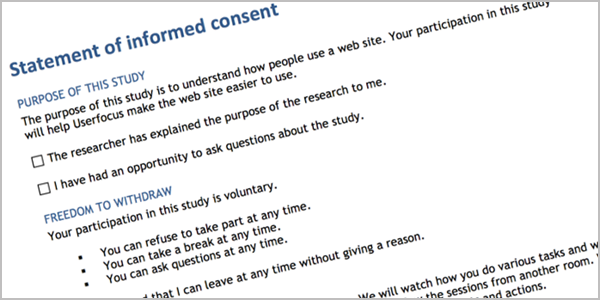
6 June, 2016 - Gaining informed consent is a cornerstone of the social sciences. But it is sometimes poorly practiced by user researchers. They fail to explain consent properly. They mix up the consent form with a non-disclosure agreement. And they mix up the consent form with the incentive. Improving the way you get consent will also improve the data you collect because participants can be more open and because it makes user researchers more empathic.
Measuring Usability With The System Usability Scale (SUS)
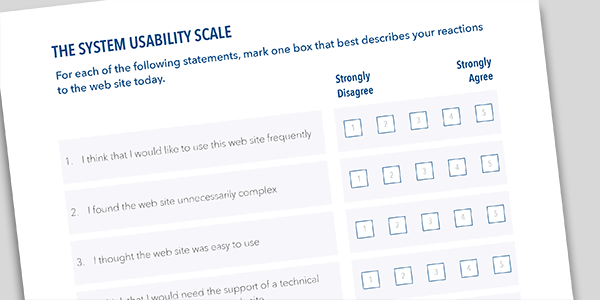
2 May, 2016 - It is the 30th anniversary of the creation of the most used questionnaire for measuring perceptions of usability. The System Usability Scale (SUS) was released into this world by John Brooke in 1986. It has become an industry standard with references in over 600 publications.
5 reasons why your first user research activity should be a usability test
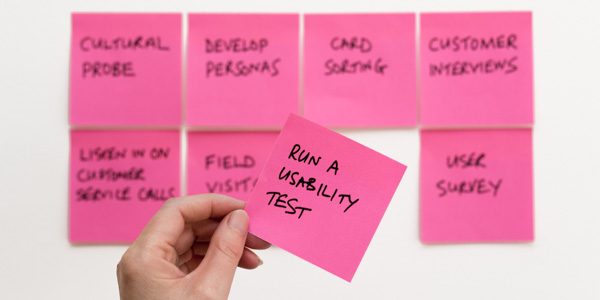
4 April, 2016 - A usability test is the wrong research method when you want to discover if there's a real user need for your product; when you want to understand the environment where your system is used; and when you want to find out how people use your product in their daily lives. So why do I almost always recommend a usability test as a team's first user research activity?
Keeping Yourself out of the Story: Controlling Experimenter Effects

7 March, 2016 - We take a look at some subtle yet pervasive experimenter effects, at ways they can bias the outcome of a design experiment, and at what we can do to control their influence.
The 4 mistakes you’ll make as a usability test moderator
1 February, 2016 - What are the most common mistakes that test moderators make? I’ve observed usability tests moderated by consultants, in-house researchers, junior user researchers and experienced practitioners and there are some common mistakes I come across time and again. These mistakes are like a rite of passage on the route to becoming a user researcher, but even experienced practitioners aren’t immune from making them.
Desk research: the what, why and how
4 January, 2016 - The "where" (at your desk) and the "when" (at the beginning of your project) are easy questions to answer. But what is it, why do you need to to do it, and how should you go about doing desk research to make sure it adds value to your project?
Uncovering user goals with the Episodic Interview

4 December, 2015 - Contextual research is the gold standard in user research. But sometimes the user researcher is called upon to run an interview out of context. How can you structure a face-to-face interview to best help users tell their stories?
Testing for a user need
5 October, 2015 - One of the most important questions faced by start-ups and established companies alike isn't, "Is my system usable?" or "Is this a great user experience?", but "Do people actually need this thing?" This article presents a structured interview technique for checking if you have identified a user need.
Are personas past their prime?
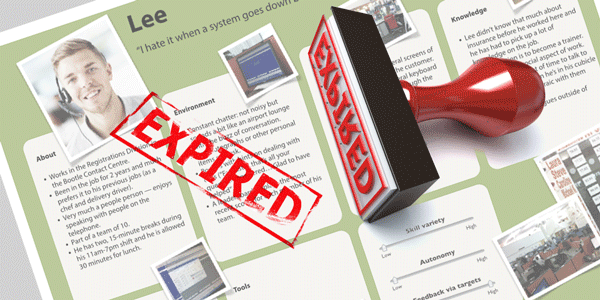
6 July, 2015 - Personas get a mixed reception from design teams, with some questioning their value. A typical criticism is that persona descriptions are superficially elegant but they lack substance. Another criticism is that persona descriptions are too 'final', and hard to update with new data. Adopting a lightweight persona description, such as the 2½D sketch, addresses these issues while retaining the strengths of traditional personas.
The three lenses of usability evaluation
7 April, 2015 - Over the last few months, I've worked with three clients who have each adopted a different approach to usability evaluation. These approaches are like different lenses used to observe the customer experience. No single approach is adequate on its own, but in combination the three approaches form a powerful strategy.
Evangelising user research

2 March, 2015 - User experience professionals often complain that design teams fail to take action on the findings from user research. But researchers need to shoulder some of the blame: research reports are often too wordy, arrive too late and fail to engage teams with the data. Dressed-down personas, customer journey maps, photo-ethnographies, affinity diagramming, screenshot forensics and hallway evangelism provide 6 alternatives.
Field visits and user interviews: 7 frequently asked questions

2 February, 2015 - When I run training courses in user research, I get a host of questions that span the range from "What's the difference between a field visit and a usability test?" through to "How do you analyse the data?" Here are my answers to the 7 most common questions that I'm asked.
The 7 Deadly Sins of User Research
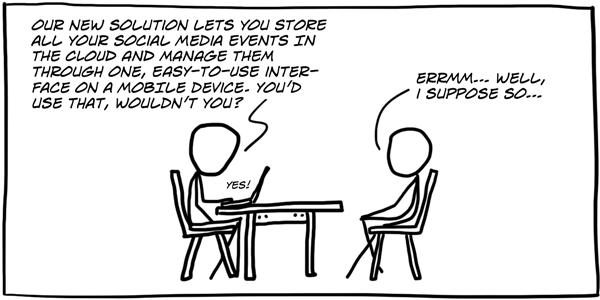
1 December, 2014 - Most companies would claim to design products and services that are simple to use. But when you ask customers to actually use these products and services, they often find them far from simple. Why is there a disconnect between what organisations think of as "simple" and what users actually experience?
60 ways to understand user needs that aren't focus groups or surveys
3 November, 2014 - People new to user research often think of surveys and focus groups as the main ways to get insights into customer needs. Here are 60 alternative ideas you might want to try.
Feature Grading: An Introduction to the Kano Model

1 September, 2014 - Imagine the scenario. You're all set to design your new app. You've done your research and identified the core set of features that you would like in your product. But your budget allows for developing 25% of these features at best. What do you do? How do you identify the features that your users really want? Enter the Kano Model.
5 provocative views on usability testing
4 August, 2014 - This month, I had the pleasure of being on a panel on usability testing at the UXPA with Rolf Mohlich, Steve Krug, and Jakob Biesterfeldt. I was asked to take a deliberately provocative view on 5 issues in usability testing. In this article, I'll argue that these 5 common beliefs about usability testing are false.
Eliciting user goals, part 1
2 June, 2014 - The great promise of user experience research is to go beyond asking people what they want and instead to discover what they need. But goal-based interviewing is difficult because it requires a very different approach to user interviews than simply running through a list of prepared questions. Two approaches that offer some promise are story elicitation and 'jobs to be done'.
How to Experiment
7 April, 2014 - With the advent of Lean UX — a kind of science of design — the ability to design and conduct an experiment should now be an important part of every designer’s skill set. But what is a design experiment? How do you develop an experiment? And how can you trust the results?
A little known factor that could have a big effect on your next usability test
3 March 2014 - Usability testing is widely accepted as the de facto method for finding usability problems with a user interface. However, test sessions can suffer from a significant ‘observer effect’. This article describes some of the evidence for the observer effect along with some suggestions for ameliorating it.
The 1-page usability test plan
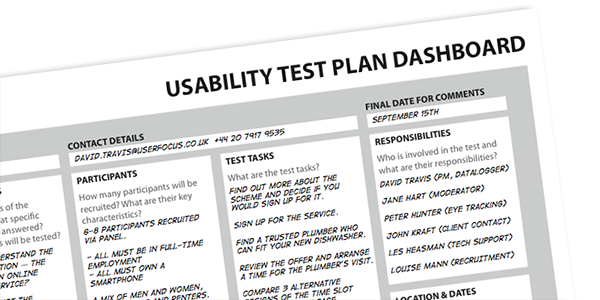
2 Sept 2013 - The Usability Test Plan is a critical document to help you manage and organise a usability test. But it can sometimes appear too documentation-heavy in agile environments. What would a usability test plan look like if it was re-envisioned as a single page?
Cheap and free under-the-radar alternatives to field visits
1 July 2013 - People in small companies or people who work as a 'UX team of one' often find it hard to gain commitment to do field research because it's perceived as too expensive or too time consuming. What quick and low-cost alternatives are available?
My place or yours? How to decide where to run your next usability test
6 May 2013 - The most common types of usability test are remote usability tests, corporate lab-based tests, contextual usability tests and rented facility tests. What are the relative strengths and weaknesses of these different approaches to usability testing and how should you choose between them?
Adapting your usability testing practise for mobile
4 Mar 2013 - There's no better way to get feedback on the usability of your mobile app than by running a usability test. Although the process is the same as when testing a desktop app, there are quite a few differences in the details. Adjust your test to take account of these differences and you'll be better placed to identify the real problems that real users will have with your app when used in an authentic context.
2 kinds of usability test
1 Oct 2012 - There are two different types of usability test and each has different aims. Which test you choose will have implications for the number of participants you test, the methodology you use and the way you log, analyse and present the data.
Dealing with difficult usability test participants
3 Sept 2012 - A common concern of people running usability tests is that sooner or later they’ll run into a difficult participant. Who are these difficult characters and how can we prevent them from being a problem?
You have 19 days to define your research problem
6 August 2012 - Without a clear understanding of a research problem one cannot expect customer or user research to deliver useful findings. Here are five things you can do to help better define a research problem and sharpen your research question.
The Beginners’ Guide to Benchmarking User Experience

2 July 2012 - Here are 6 steps for benchmarking your user experience designs against your client’s business objectives. The same approach works whether your clients are internal to your organisation or external. The approach works for web sites, mobile apps, desktop software, intranets, consumer products, even services.
The Wizard of Oz guide to usability testing mobile prototypes
1 May 2012 - It's easy to create a mobile prototype on a desktop computer. What's not quite so easy is to usability test the prototype and still allow the participant to use mobile interaction gestures like long presses and two finger pinches. We can overcome this obstacle by combining Axure's mutually exclusive non-conditional cases with Wizard of Oz usability testing.
Lean ways to test your new business idea
5 March 2012 - In ‘The Lean Startup’, Eric Ries describes a design process to help manage risk when developing new products and services under conditions of extreme uncertainty. This article describes three established user experience techniques we can use to support this design process: narrative storyboarding; paper prototyping; and the Wizard of Oz.
What user researchers can learn from Sherlock Holmes
4 October 2011 - The parallels between good research and good detective work are striking. In this article we take a close look at what user experience researchers can learn from the investigative methods used by detectives. And, in the spirit of all the best detective stories, we draw an important conclusion: if you want to become a better researcher you should learn to think like a detective.
Do you make these 4 mistakes when carrying out a usability review?
1 September 2011 - When properly carried out, usability reviews are a very efficient way of finding the usability bloopers in an interface. But there are four common mistakes made by novice reviewers: failing to take the user’s perspective; using only a single reviewer, rather than collating the results from a team; using a generic set of usability principles rather than technology-specific guidelines; and lacking the experience to judge which problems are important.
4 forgotten principles of usability testing
7 March 2011 - Many usability tests are worthless. Researchers recruit the wrong kind of participants, test the wrong kind of tasks, put too much weight on people's opinions, and expect participants to generate design solutions.
The 5 habits of highly effective field researchers
6 September 2010 - You may not get many chances to visit and observe your customers at their place of work, so you want to make the most of the opportunity. But what's the best way to run a site visit? Highly effective field researchers show 5 specific behaviours. They create a focus question, audio record the sessions, take photographs of the environment, take notes and write up a short summary of the observation immediately.
The 4 questions to ask in a cognitive walkthrough
3 August 2010 - Although the cognitive walkthrough gets less coverage than Nielsen’s heuristic evaluation, it’s just as effective at uncovering interaction problems. It’s also an ideal way to identify problems that users will have when they first use an interface, without training.
Creating usability test tasks that really motivate users
5 July 2010 - The magic of usability tests is that you get to see what people actually do with a system (rather than what they say they do). This gives you great insights into how people behave and how to improve your design. But if your tasks lack realism you'll find that people just go through the motions and don't engage with the test — reducing the credibility of your results. Here are 6 ways to captivate participants with great test tasks.
Web survey design step-by-step
1 June 2010 - Many people think that the key to great web surveys is to craft good questions. Creating good questions is important but this is really just a small part of the battle. To design great web surveys you need to follow 6 steps. Following these steps will help you get the valid and accurate data you need to drive commercial business decisions.
Creative ways to solve usability problems
6 May 2010 - It's sometimes said that usability professionals are good at finding problems, but not quite as good at coming up with creative solutions. This article describes a creativity technique called SCAMPER that will help you effortlessly generate dozens of design solutions to any usability problem you identify.
Log usability tests like a pro
1 Apr 2010 - Observing a usability test seems simple but it's easy to lose focus during a session and record only the dramatic or obvious usability problems. As you watch the test, you should make minute-by-minute observations of the participant's behaviour as single letter codes. Datalogging ensures you note all behaviours, not just the ones that stand out, and provides all you need to quickly create a list of usability issues you can pass to the design team. This article includes a macro-free Excel spreadsheet you can use to timestamp your observations.
Usability testing with hard-to-find participants
2 Nov 2009 - For most products, it's easy to track down participants for a usability test. But there are some products where end-users are difficult to find and recruit. For these products, it's better to use surrogate users as a proxy for genuine users than not to usability test at all, but you must manage the risks appropriately.
How to prioritise usability problems
5 Oct 2009 - A typical usability test may return over 100 usability issues. How can you prioritise the issues so that the development team know which ones are the most serious? By asking just 3 questions of any usability problem, we are able to classify its severity as low, medium, serious or critical.
How to create personas your design team will believe in
3 Aug 2009 - Does your organisation use personas to describe users' characteristics, goals, needs and behaviours? Although they are a popular tool for communicating knowledge about users, many personas are little more than anecdote, hearsay and rumour. These kind of fake personas rapidly fall into disuse. Make sure your own personas get used by validating them against this 7-item checklist.
Usability Test Moderation: The Comic
1 June 2009 - If you've been tasked with running a usability test, then you'll love this instructional guide. Aimed at people about to moderate their first usability test, this free graphic instruction guide covers the essential techniques you'll need to moderate a usability test.
What every usability test moderator ought to know about good listening
6 May 2009 - Moderation seems effortless but there's a lot more to good listening than opening your ears. Here are 15 suggestions to improve your own listening skills.
New standards in usability
13 Jan 2009 - 2008 saw the release of several international usability standards, many within the influential ISO 9241 series. Two of these standards focus on accessibility and another provides guidelines for usable web sites. This article explains why usability standards are important and summarises the 13 new parts of ISO 9241.
Writing the perfect participant screener
6 Nov 2008 - "Know thy user" is the first principle of usability, so it's important that you involve the right kind of people in your usability study. These 8 tips for screening participants will show you how to recruit articulate, representative users for your research, quickly filter out the people you don't want and help you avoid the dreaded "no show".
How to run an unmoderated usability test
4 Sep 2008 - In an unmoderated usability test, a computer automates the process of administering a usability test. This means you can test with much larger samples than with a conventional test, calculate reliable measures of usability and feel confident that you're capturing your customer's context of use.
Morae for Usability Practitioners
2 Aug 2008 - Targeted at both new and experienced users of Morae, Morae for Usability Practitioners is a step-by-step guide to using Morae to plan, execute and analyse usability tests. Packed with insider tips and expert advice, this guide will help you use Morae to its full potential.
Site visit interviews: from good to great
2 Aug 2008 - Site visits are the best method we have of gaining real insight into the way customers work — to understand what customers do, rather than what they say they do. But to get the most from a site visit you need to polish your interviewing skills. Great interviewers show five characteristics from which we can learn.
Measuring the usability of everyday products
2 Jun 2008 - ISO have released a new standard for measuring the usability of every day products, like ticket machines, mobile phones and digital cameras. This standard, ISO 20282, includes test methods for quantifying the usability of consumer products to ensure they meet a pre-defined quality level. This development is exciting because the standard's focus on usability measurement reflects a sea change in the evolving practice of usability. In the old world, usability specialists just found usability problems with a design. In the new world, usability specialists also answer the question: "How usable is this design?"
Data collection for usability research
5 May 2008 - How should you go about collecting data in usability tests? This article examines the data collection process in usability studies and describes some popular data logging solutions. Since most of these tools are expensive, we show you how you can use Microsoft Excel with Visual Basic macros to collect the data.
SPSS: Statistics for the mathematically challenged
2 Apr 2008 - Many people enjoy behavioural research, whether it's running a usability test, fielding a survey or observing people doing their jobs. Finding things out and making new discoveries excites our natural human curiosity. But when faced with the task of analysing the data behind the research, many people feel their excitement drain away. Most of us are not excellent mathematicians and the notion of using data to test scientific hypotheses can be intimidating. But data analysis is an important aspect of virtually all research. So how can you overcome a fear of maths to learn how to use statistics?
Usability test datalogger
2 Apr 2008 - This Excel spreadsheet allows you to measure task completion rates, time-on-task, analyse questionnaire data, and summarise participant comments. Latest version just released!
Measuring satisfaction: Beyond the usability questionnaire
3 Mar 2008 - Most usability tests culminate with a short questionnaire that asks the participant to rate, usually on a 5- or 7-point scale, various characteristics of the system. Experience shows that participants are reluctant to be critical of a system, no matter how difficult they found the tasks. This article describes a guided interview technique that overcomes this problem based on a word list of over 100 adjectives. We also include a spreadsheet to generate and randomise the word list.
Measuring usability with the Common Industry Format (CIF)
4 Feb 2008 - Are you a CIO, purchasing officer, or IT manager, about to invest in productivity software for your company? If you are, here's a question you should ask your supplier before you sign on the dotted line: "Just how usable is this product?" Astonishingly, most companies won't be able to answer, and those that try will answer the question only vaguely. But now help is at hand. It's called CIF. And it's about to change the game.
Why you shouldn't ask “Why?” in a usability test
3 Sep 2007 - This year marks an important anniversary for people who moderate usability tests. In a classic study carried out exactly 30 years ago, psychologists showed that people are very poor at explaining the reasons behind their choices. This is why usability tests focus on what people do, not on what people say. So why do so many usability test moderators continue to ask participants, "Why"?
Heuristic Evaluation with Morae
2 Aug 2007 (Updated 6 Jun 2009) - Every usability professional knows that Morae is a useful tool for running a software or web usability test. But did you know you could also use it to dramatically speed up the time it takes to do a heuristic evaluation? This 'How do I…' article gives you step-by-step instructions on how to carry out an expert review with Morae, complete with explanatory screen shots.
20 tips for writing web surveys
1 May 2007 - Many people think questionnaire and survey design is common sense. If that's true then common sense can't be that common because many surveys on the web are very poorly designed. For example, surveys often ask irrelevant questions or biased questions or just too many questions. These problems make the resulting data impossible to analyse. This article reviews best practice in survey design.
Usability Expert Reviews: Beyond Heuristic Evaluation
16 Apr 2007 - Most people that carry out usability expert reviews use Jakob Nielsen's ten usability 'heuristics'. Many of these guidelines are common sense but they are not based on substantive research. The International usability standard, BS EN-ISO 9241-110 proposes an alternative set of seven guidelines. These guidelines have the benefit of international consensus and they can be applied to any interactive system.
Usability Test Plan Toolkit
2 Jan 2007 - This eBook contains all you need to make sure that you're fully prepared for your next usability test. The document includes easy to customise usability test forms, such as screeners, a discussion guide, questionnaires and data logging sheets.
Red route usability

25 Mar 2006 - Important roads in London are known as 'red routes' and Transport for London do everything in their power to make sure passenger journeys on these routes are completed as smoothly and quickly as possible. Define the red routes for your web site and you'll be able to identify and eliminate any usability obstacles on the key user journeys.
Is Consumer Research Losing Its Focus?
1 Jun 2004 - Focus groups continually fail to tell us what customers want. The fundamental problem is that, in spite of what conventional wisdom tells us, it is not the voice of the consumer that matters. What matters is the mind of the consumer. The big mistake is in believing that what the mind thinks, the voice speaks. It is time to start embracing methods that can deliver stronger predictive value.
Usability test data
17 Jun 2003 - People often throw around the terms "objective" and "subjective" when talking about the results of a usability test. These terms are frequently equated with the statistical terms "quantitative" and "qualitative". The analogy is false, and this misunderstanding can have consequences for the interpretations and conclusions of usability tests.
Standards update: Usability test reporting
5 Jun 2003 (Updated 21 Apr 2006) - It's a truism that even a bad usability test will help improve your software. But the findings from different usability tests are notoriously difficult to compare. This makes it difficult to track usability improvements or to see how you compare against an earlier product. A new international standard looks set to solve this problem.
Discount usability: time to push back the pendulum?
2 May 2003 - Discount usability techniques are a great way to eradicate usability problems. But they can never answer the question, "How usable is this system?" We blow the dust off some techniques commonly used in the early days of usability testing to see if they can provide an answer.
Checkpoints for reviewing usability test reports
10 Jan 2005 - Usability practitioners are called on, not only to conduct many research studies during their careers, but also to read, review, and advise on usability studies that have been conducted and reported by others. The ability to critically review the research of others, and to help stakeholders weigh up the merits or shortcomings of research data and conclusions, is an extremely valuable skill. These checkpoints will help you ensure your review covers the key issues.
User Experience Design articles & resources
Bright Ideas for User Experience Designers
If you're a user experience designer, start here. This eBook contains 100 pages of real-world help on everything from prototyping to writing user support.
Talking to computers (part 2): VUI as an error recovery system
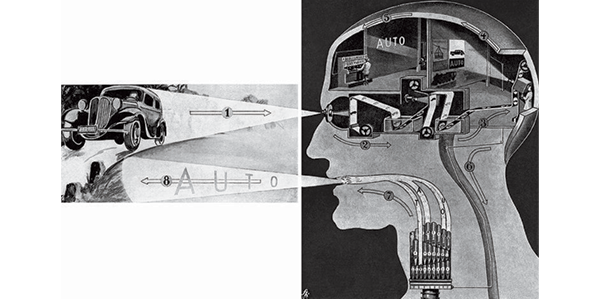
1 July, 2019 - I take a closer look at some unavoidable challenges to effective speech recognition, and I discuss why you may want to think twice before designing dialogue that is 'conversational' and 'natural'. I also offer five important questions that I think should form the basis of any VUI design kick-off meeting.
Talking to computers (part 1): Why is speech recognition so difficult?

3 June, 2019 - Although the performance of today's speech recognition systems is impressive, the experience for many is still one of errors, corrections, frustration and abandoning speech in favour of alternative interaction methods. We take a closer look at speech and find out why speech recognition is so difficult.
The Principle of Least Surprise
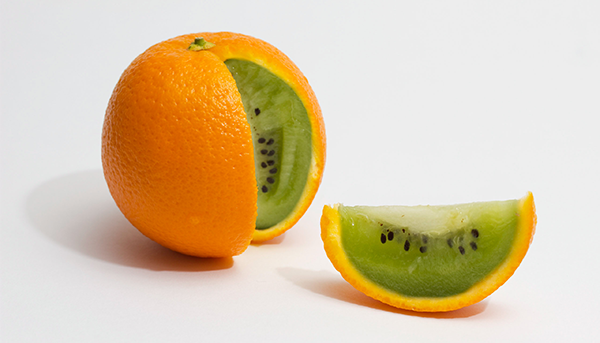
6 May, 2019 - Consistency is at the heart of good product design. But consistency is often misinterpreted as making things look or behave the same way. This ignores context and can lead to a foolish consistency. Instead of consistency, designers should adhere to the Principle of Least Surprise.
What user researchers can bring to the Design Studio Methodology
7 September, 2015 - The Design Studio is a wonderful methodology to encourage multidisciplinary design, but in practice teams often create design concepts that aren't grounded in user research. We can bake user research findings into every design concept that emerges by using the context of use (users, goals and environments) as a constraint. As an added bonus, this approach helps teams create many more solutions to a design problem.
What car park payment machines can teach us about usability
1 September, 2014 - Car park payment machines provide an every-day example of poor usability. They teach us that technology should not drive design, that less important tasks should not dominate the user interface and that usability is more than visual design. They also teach us that usability doesn't always matter in design, the best user interface is no interface and that usability is a differentiator only when customers have a choice.
Reusing cases across different widgets and events in Axure RP Pro
7 July, 2014 - During our Axure training courses, delegates often ask if it is possible to reuse cases across different events and widgets. In this article, we show how to define a library of sub-routines in Axure that can be reused by exploiting Axure's Dynamic Panels.
How red routes can help you take charge of your product backlog

3 Feb 2014 - "Design is easy," writes branding expert Marty Neumeier. "All you do is stare at the screen until drops of blood form on your forehead." One element that makes design difficult is a lack of constraints. Focusing on your product's red routes provides the key constraint you need to ship a high value product from version 1.
The usability error you don't know you're making
8 Apr 2013 - Failing to speak the user's language is an easy trap to fall into because you may not know the user's vocabulary and because technical terms often become second nature to the design team. As with much of user centred design, the secret lies in getting closer to your users so you can empathise with them.
What Russian dolls and Fantastic Voyage can teach us about designing for mobile
4 Feb 2013 - You can't create a mobile version of a desktop system simply by shrinking the screen. You need to re-conceptualise the application and design for red routes, fat fingers and transient use.
Confessions of an Axure Master: 5 shortcuts for laying out Axure pages in record time
2 July 2012 - One of the quickest ways to speed up your use of software is to learn shortcuts. Here are 5 little-used shortcuts for Axure that will help you work like an expert.
Help! What The Beatles can teach us about writing support material
1 June 2012 - Reading user instructions continues to rank high on people’s lists of ‘activities-to-be-avoided-at-all-possible-costs’. We’ve worked with a number of clients to improve their user support materials and we frequently encounter five common mistakes made by development teams. This work has given us some insight into how best to avoid these problems occurring in the first place.
4 ways to prototype faster
5 December 2011 - “Lean UX” is the new black. We can summarise the philosophy behind it by saying: If a picture is worth a 1000 words, then a prototype is worth a 1000 pictures (with apologies to Ben Shneiderman). But given that we are increasingly working in environments where we need to deliver more with less, how can we speed up the process of prototyping?
A CRAP way to improve usability
1 August 2011 - Visual design is often dismissed as eye candy. In fact, we can use four key principles of visual design to create more usable interfaces. These principles are Contrast, Repetition, Alignment and Proximity.
5 kinds of 'alt' text
7 February 2011 - There are five different classes of image used on web pages and each class of image requires a different approach to writing the 'alt' attribute.
7 myths about paper prototyping
6 December 2010 - Paper prototyping is probably the best tool we have to design great user experiences. It allows you to involve users early in the design process, shows you how people will use your system before you've written any code, and supports iterative design. So why are some design teams still resistant to using it? Here are 7 objections I've heard to paper prototyping and why each one is mistaken.
Communicating errors
11 November 2010 - Ideally, you'll design your system to prevent errors from occurring in the first place. But no matter how simple your system, someone, somewhere, will make an error when using it. The difference between a great user experience and an awful one is what your system does next.
Usability for Medical Devices: A New International Standard
1 Mar 2010 - A recently published international standard requires manufacturers of medical devices to follow a systematic usability process. To comply, manufacturers of medical devices will need to change the way they design, develop, test and manufacture their systems.
Card Games for Information Architects
1 Feb 2010 - This article reviews 6 simple but powerful research techniques you can use to improve the information architecture of your product or web site. None of these activities requires a computer. You simply need a bunch of cards, a participant and a desk.
247 Web Usability Guidelines

6 July 2009 - Although designing usable systems requires far more than simply applying guidelines, guidelines can still make a significant contribution to usability by promoting consistency and good practice. This article contains a list of 247 guidelines we use for expert reviews in our consultancy work. You can also download the guidelines as an Excel workbook.
Shopping basket usability: Nine tests for a usable checkout
1 Dec 2008 - With consumer budgets tightening, retailers need to fix every potential leak in their e-commerce site. Many sites lose customers during the series of screens that appear after the customer clicks the checkout button. We've observed hundreds of e-commerce sessions in our usability labs and the best performing sites demonstrate these 9 features.
Layout grids for Axure and Pencil
3 Jul 2008 - Designed for use with Axure RP Pro 5 and the Pencil extension for Firefox, this resource will help you layout prototype web pages using the 960-grid system.
Dragons' Den Usability
5 Jan 2008 - It's easy to get caught up in the promise of new technologies and lose sight of the fundamental issues that make a product successful. By listening to the questions venture capitalists pose when reviewing new products we can develop a checklist to assess the viability of a new product idea.
Paper Prototyping with Morae
3 Dec 2007 - Morae makes it easy to log usability tests, create video highlights and allow observers to view a test in progress. But Morae is designed to support usability tests of software, not paper prototypes. This how-to article shows you how to exploit the full functionality of Morae when carrying out a paper prototype test.
ISO 9241 for Beginners
2 Sep 2007 - This white paper describes each of the many parts of ISO 9241 in detail. Now available for viewing on-line and off-line (in pdf and epub format).
Usability RSS feeds
2 Aug 2007 - Are you finding it difficult to keep up with the variety of web sites, blogs and articles devoted to usability? If so, help is at hand. We've put together a web page that aggregates the best of these web sites and made the page available through Netvibes.
The A-Z of Usability
4 Jul 2007 - Rather than create yet another definition of usability, we decided to take a different approach and work through the alphabet, picking one word for each letter to capture the flavour of the field. So we proudly present the A-Z of usability — or usability in 26 words.
Tips for writing user manuals

4 Jun 2007 - User manuals have a bad reputation. In a recent USA Today poll that asked readers "Which technological things have the ability to confuse you?" user manuals came out top! Increasingly companies are rethinking the way they approach user manuals. Here are some suggestions for improving the usability of user manuals based on our experience writing them.
Web accessibility tools
3 Sep 2006 - A concise list of the most useful accessibility tools on the Web. These tools and web sites are indispensable when carrying out accessibility reviews.
Four ideas for better forms
25 Apr 2005 - Do you have an uneasy feeling that your forms aren't working as well as they should? Or are you simply looking for ways of making them even better? Here are four ideas for better forms.
Web Standards: User Interface Makeovers
16 Aug 2004 - We often come across the misperception that an accessible site means an ugly site. In fact, by following standards, designers can create virtually any visual design yet still make it accessible. Just to prove it, our associate Trevor Morris carried out makeovers of nokia.com and vodafone.co.uk. Neither site met even the minimum levels of accessibility before he started. Once he had finished, both sites were "AAA" accessible. This is of enormous benefit to a disabled user — yet to a sighted user the original and "madeover" sites look virtually identical.
Web Accessibility: No More Mr Nice Guy
23 Apr 2004 - Last week the Disability Rights Commission (DRC) published a significant report on web accessibility. This report marks the DRC’s intention to get tough with organisations whose web sites cannot be used by disabled people. Over the next twelve months, we predict that the report will influence redesigns of virtually every major web site in the UK as organisations jockey with each other to avoid getting sued.
Web Usability: A New International Standard
5 Feb 2004 - ISO is developing a new standard for web usability. The new standard will be of interest to anyone who designs, evaluates or commissions web sites and it is likely to have a significant impact in improving the overall usability of the web.
UX Stencil for Omnigraffle, Visio, Pencil & Keynote
15 Aug 2011 - These stencils will help you communicate user-centered design activities and proposals to clients and development teams.
E-Commerce Usability
This e-commerce usability book introduced the notion of "customer centred design".
Effective Color Displays
This book is for people who want to use color effectively in user interface design.
User Experience Strategy articles & resources
Bright Ideas for User Experience Managers
If you're a user experience manager (or just like to take a strategic view), start here. This eBook contains 78 pages of real-world help on subjects like recruiting UX staff, selling usability and institutionalising usability in your organisation.
'And the award goes to…' How to avoid winning a Procrustes Award for bad UX

1 Apr, 2019 - We're familiar with awarding prizes for excellence, from the Oscars to The International Design Awards. But what if we started giving prizes to shame bad examples of design? Enter the Procrustes Awards.
Is UX Certification worth it?
4 Feb, 2019 - BCS launched their Foundation Certificate in User Experience 3 years ago. We thought this was an opportune time to review its effectiveness. We contacted candidates who had taken (and passed) the certificate through Userfocus and asked, "What impact has attaining the BCS Foundation Certificate in UX had on your job?" Ten key themes emerged.
12 symptoms of a back-to-front design process

7 Jan, 2019 - Everyday consumer products continue to frustrate people. The failure of companies to fully embrace UX is partly to blame, but there is also another reason — one that is seldom discussed. Consumer product companies pay too much heed to their retail customers and, in so doing, they prevent the development team from getting first-hand knowledge of end users.
How to create a POWERful case study for your UX portfolio

1 August, 2018 - Writing a case study is the way a UX researcher demonstrates their value. Case studies aren't just for UX portfolios or for consulting proposals: they provide a narrative to describe your work to friends and colleagues. The best case studies are simple stories that can be re-told in your absence and the POWER framework provides the scaffolding to compose your case study.
Do I need a Masters in User Experience?

3 May, 2018 - A Masters in UX costs over £10k and may not make you more employable or attract a higher salary compared with spending the same time gaining practical experience in UX. Before you decide on taking that Masters degree, consider what you could achieve for 10% of the investment by creating an alternative, self-paced, personalised syllabus.
Steve Jobs on 6 key principles of user experience
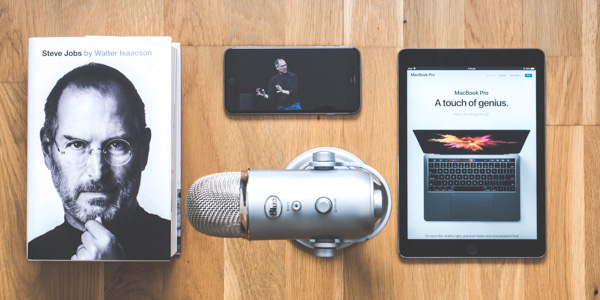
5 March, 2018 - A good quotation can be a powerful communication tool. And Steve Jobs, perhaps history's best design communicator, left us with some profound words. Jobs had an intuitive understanding of great design and user experience as these quotations show.
30 Days of User Experience — The Bathroom Edition
4 May, 2017 - '30 Days of User Experience' is a downloadable PDF to print out and place in your workplace bathroom to encourage people to engage in UX activities.
Is Usability a Science?

3 April, 2017 - Recently, Todd Zazelenchuk, David Travis and I met up at our favourite watering hole in Staffordshire. As is often the case we stumbled into a discussion about usability, this time mulling over the question of whether usability is or is not a science. It turned out to be a slightly more challenging question than we had expected. Cut to the pub—
Why iterative design isn't enough to create innovative products

6 March, 2017 - Iterative design is a proven approach for optimising the usability of a product or service. Teams create prototypes, test them with users, find problems and fix them. But iterative design does not guarantee innovation. To develop innovative designs, we need to question the way we have framed the problem and instead focus on our users' underlying needs.
The 8 competencies of user experience: a tool for assessing and developing UX Practitioners
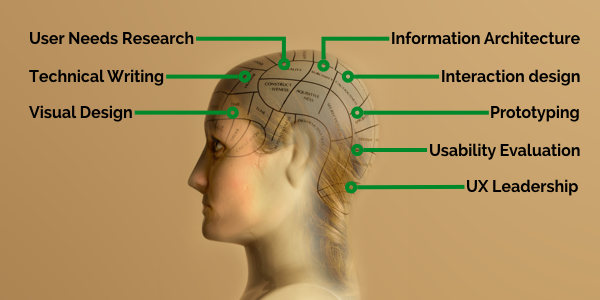
A UX practitioner demonstrates 8 core competencies: User needs research; Usability evaluation; Information architecture; Interaction design; Visual design; Technical writing; User interface prototyping; and User experience leadership. By assessing each team member's 'signature' in these eight areas, managers can build a fully rounded user experience team. This approach also helps identify the roles for which each team member is most suited alongside areas for individual development.
Non-UX books that every UX practitioner should read

In this article, Philip Hodgson, David Travis and Todd Zazelenchuk share their shortlists of non-UX books for those working in UX… an intentional twist on the usual lists that recommend books about user research and user experience design. So don’t be surprised to find that The Design of Everyday Things, among other classics, is not in this list. No disrespect. No oversight. Simply a different list for you to consider.
What one UX skill or ability is the most important to master?
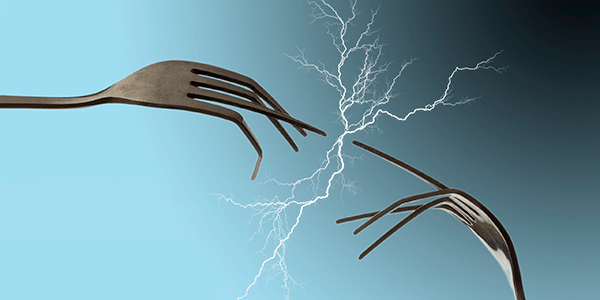
User Experience is a multi-disciplinary specialty and that means UX practitioners must master several methods, techniques and skills. Recently — partly as a thought exercise, and partly in an attempt to tap into what might be the essence of user research and design — I wondered if just one skill or ability deserved to stand out from the rest. Here’s how five UX specialists answered that question.
What do we mean by user experience leadership?

5 October, 2016 - As winter begins to approach, there's not much to beat a pint at the local pub in front of a roaring fire. So Philip Hodgson, Todd Zazelenchuk and I headed to a pub in Staffordshire for a drink. Over three pints of fine ale, we relaxed into a discussion about user experience leadership. Like most discussions in the pub, I realised this one would be lost in the mists of time by morning, so I decided to turn on a voice recorder…
Usability maturity, 13 years on
2 November, 2015 - 13 years ago this month I sent my book, 'E-Commerce Usability', to the publishers. I found myself flicking through a copy this week and re-discovered a 'Usability Maturity' quiz that I created for the book. These questions are just as relevant today as they were 13 years ago.
A task-focussed user experience reading list

3 August, 2015 - Clients and students I work with often ask me to recommend a good book on user experience. This is actually a lot harder than you might think. Someone who’s new to the field won’t gain much from a book aimed at experts, and someone looking to improve their sketching skills won’t learn much from a book about usability testing. So here is my list of recommended books along with the people I think they are best suited for.
6 mistakes that prevent UX teams from having boardroom influence
1 June, 2015 - We're seeing a sea-change in our industry as firms scramble to build fledgling user experience (UX) teams. While this is a sure sign of a maturing discipline, it is not without its teething problems. In particular, the voice of the UX team can sometimes sound more like a whisper. Why do some UX teams fail to achieve the impact expected of them? Here are 6 mistakes we've seen in UX teams that prevent them from having boardroom influence.
Why I changed my mind about UX Certification

5 May, 2015 - I'll admit it: when I used to hear people advocate professional certification in user experience, I was dismissive. Since we can't even agree on what 'UX' is, how can we certify it? I wondered. I saw certification as a way of creating a closed shop to exclude dissenting voices. This is the story of how I changed my mind.
Conducting an effective stakeholder interview

6 October, 2014 - There are few things more likely to make your design or UX project difficult than a poorly conducted stakeholder meeting. Structuring your stakeholder interview around a few simple techniques will ensure you get off to a good start and set you up for success.
Eric Morecambe's lesson for user experience teams
5 May, 2014 - Over 40 years ago, comedy duo Morecambe & Wise filmed a now legendary sketch for a television Christmas special. Scratch below the surface of this sketch and you'll discover an important lesson for user experience teams.
The missing role in your design team
6 Jan 2014 - Design teams often experience a common set of growing pains. They design for themselves; don't know how to choose between design alternatives; accept poor quality design research; prioritise what users say over what users do; and focus on usability and not on the user experience. Adding a psychologist to your team can help fix these problems.
The UX debrief: A tale of two meetings
2 Dec 2013 - UX debrief meetings are sometimes viewed as little more than a way to wrap-up a project. This is a mistake. A UX debrief meeting can accomplish much more than just tie a bow on the project. But it's easier to get a debrief meeting wrong than it is to get it right — as I painfully discovered during the debrief meeting from hell.
How to wow me with your UX research portfolio
4 Nov 2013 - If you work in user experience, the portfolio has replaced your CV. This is fine if you are a visual designer but for people who specialise in user experience research, the portfolio poses a particular challenge. Here are some suggestions on ways to create a winning user experience research portfolio.
Does your company deliver a superior customer experience?
7 Oct 2013 - Many companies think of themselves as user focused but this judgement is often based on anecdotal or biased data. To truly deliver a superior customer experience, companies need to progress through four stages of maturity, finally arriving at a point where feedback is not simply welcomed or solicited — but demanded.
How Carl Sagan’s Baloney Detection Kit can help save your project (and maybe your company)
5 August 2013 - Most new products fail within the first few months after launch. This article describes 10 critical thinking tools that can be used to flag concerns about the project you are working on. These rules can be used by all team members to help save — or in some cases, kill off — struggling projects.
What Gordon Ramsay can teach us about giving feedback to design teams
3 June 2013 - The Michelin-starred chef and restaurant troubleshooter can teach us a thing or two about providing design criticism, although some of it you may wish to avoid.
"I want to speak to my users but they don't want to speak to me"
7 Jan 2013 - Making user experience happen within an organisation requires development teams to start involving users. This can be a difficult prospect for teams who have not engaged with users in the past. Here are 10 suggestions to help you make that first all-important contact with users.
Building a bridge between marketing and usability
3 Dec 2012 - To be an effective representative of both the user and the designer, and to help steer decision-making, usability practitioners must find a way to influence retailers of consumer products. That means building a new partnership with marketing.
The 15 warning signs that marketing is blocking your view of the user
5 Nov 2012 - It won’t have escaped your notice that despite many companies investing in user experience, everyday consumer products still have the ability to frustrate the living daylights out of people. I argue this is because marketing teams, influenced by big retailers, unwittingly block the design team’s view of the end user.
The Monty Python guide to user experience design
3 Sept 2012 - What's the difference between information architecture, interaction design, visual design and usability engineering? I argue that each of these areas is critical in a design project but that they need to be co-ordinated by a User Experience Designer to ensure the end user's experience is a satisfying one.
How to tell managers they’re wrong about UX research and still get hired
2 April 2012 - Heard these before? ‘Market research uses hundreds of people. How come you can get answers with just 5?’ ‘Our product is aimed at everyone, so we can use ourselves as users.’ ‘Users don‘t know what they want’ ‘Apple doesn‘t do user research so why should we?’ ‘Our agency does all of this for us.’ Here's how to successfully counter each of these objections.
What makes a great UX practitioner? Hint: It's not what you think
6 February 2012 - Most of the work on user experience (UX) competency focuses on an individual’s ability to show evidence of technical skills. But technical skill is just one sphere of expertise required by UX practitioners. A fully-rounded UX practitioner also needs competence in two additional spheres of practice: process and marketing.
20 things you can do this year to improve your user’s experience
4 January 2012 - The new year is as good a time as any to review and improve the way you work. With a good user experience now widely seen as the key attribute of many high-tech products, it makes sense to review your own products to see how you can give them that user experience edge. Here are 20 quick, simple and virtually free ideas you can apply in 2012.
How to manage design projects with user experience metrics
7 November 2011 - User experience metrics are measures that help you assess how your design stacks up against the needs of your customers and the needs of your business. Lab-based methods of collecting UX metrics are too slow and expensive to be part of most design projects, especially those using agile methodologies. But with online usability testing tools, regular user experience benchmarking is now cheap and quick to carry out.
Games Usability Trainers Play
4 July 2011 - Lecturing to people is a poor way to help them learn new facts. People learn better when they are actively engaged in their learning. Here's a training game that we use on one of our training courses to help people learn about usability heuristics. Why not play this game with your user experience team during your next team meeting?
ISO 13407 is dead. Long live ISO 9241-210!
6 June 2011 - An important usability standard has been updated for the user experience era. The standard describes 6 key principles of human centred design and serves as a manifesto for the field of user experience.
How to design like Leonardo da Vinci
2 May 2011 - Trying to recruit a single individual with all of the skills needed to create great user experiences is like trying to hire a modern-day Leonardo da Vinci. A better strategy is to build a multidisciplinary team with people specialised in the following areas: Management, Research, Information Architecture, Information Design, Visual Design, Technical Writing and Prototyping.
Making usability metrics count
4 April 2011 - In spite of a proliferation of books, articles and blogs explaining how to measure usability, few companies seem to put their usability metrics to good use. In this article we show how you can link the numbers from usability tests to the numbers that steer business decisions — and in the process, influence your company's business.
Why you need a user experience vision (and how to create and publicise it)
5 January 2011 - Many design teams launch into development without a shared vision of the user experience. Without this shared vision, the team lacks direction, challenge and focus. This article describes how to use the 'Design the Box' activity to develop a user experience vision, and then describes three ways of publicising the vision: telling a short story; drawing a cartoon showing the experience; and creating a video to illustrate the future.
How to recruit a UX leader with the X factor

4 October 2010 - We're increasingly asked by organisations for advice on building a user experience competency. Our advice is to start at the top and get the right person for that first critical leadership role. User experience leaders demonstrate 3 core competencies: they understand research; they follow user experience methods and standards; and they are great communicators.
12 ways to turbocharge your usability career
4 Jan 2010 - Do you spend so much time firefighting that you forget to think about your career? January is as good a time as any to think about improving your career prospects so here are some tips to help you get more from your job — or even get a better job. Presented as 12 bite-sized, monthly activities, do just one a month and watch your career take off this year.
The Fable of the User-Centred Designer
7 Dec 2009 - Follow a young man's journey as he discovers the three secrets of user-centred design. After reading this 40-page fable, you'll understand the framework of user-centred design and know how to apply it to your own design project. It's a small book that has big results.
Communicating User Experience Design
7 Sept 2009 - When trying to communicate the process of user centred design to senior managers it helps to convey the idea as concisely as possible. This infographic conveys the various steps and phases of user centred design on a single page.
How to create a usability test highlights video you can be proud of
8 Apr 2009 - There's no shortage of software that will record videos from usability tests, but how do you put the clips together in a way that will convince management and the design team to take action on your results? Our solution is to use the rule of 5: Create 5 separate highlights videos each focusing on one usability issue, with each issue comprising 5 clips and with each video lasting 5 minutes or less.
Two measures that will justify any design change
9 Mar 2009 - Two measures commonly taken in a usability test — success rate and time on task — are the critical numbers you need to prove the benefits of almost any potential design change. These values can be re-expressed in the language that managers understand: the expected financial benefit.
Creating a usability dashboard
10 Feb 2009 - We're often told that senior managers don't have the time to read a detailed report describing the findings from a usability test. This means our thoroughly argued, carefully analysed and clearly presented 60-page report could have no effect on improving the product or changing the culture. How can we better engage managers with our data?
Credit-Crunch Usability: 10 ways to maximise your usability budget
1 Oct 2008 - Being frugal during economic hard times is good business practice. So how can you squeeze your usability budget and still deliver great insights? These 10 suggestions for streamlining your usability efforts explode the myth that usability is expensive and time-consuming.
A Business Case for Usability
1 Oct 2007 - Until usability gets embedded in the processes of your company, you'll probably find you need to justify the investment. Fortunately, usability initiatives deliver a major return on investment: it's not unusual for usability projects to return benefits of 5-10 times their cost in the first year alone.
Selling usability to your manager
2 Nov 2006 - Before you can implement a usability initiative in your organisation, you'll need to convince your manager it's worthwhile. The obvious approach is to use a cost-benefit argument, but experience shows that this approach often fails because many managers find the data unconvincing. An alternative approach is to tailor your argument based on your manager's MBTI personality type. This approach generates many different ideas for selling usability within your organisation and is much more persuasive.
Institutionalising Usability: 5 Ways to embed usability in your company
24 Sep 2005 - Trying to embed usability in an organisation needs more than persuasive, logical arguments. You also need to appeal to managers' emotions and political ambitions. This article describes five successful strategies that we've seen work in companies large and small.
World Usability Day Quotation posters
14 Nov 2006 - “A mobile phone needs a manual in the way a teacup doesn't.” Brighten up your office and help spread the word with one of our World Usability Day quotation posters. Or print a couple on postcard-sized photo paper and send them to manufacturers of hard-to-use products with your own witty aphorism on the back.
Are you customer centred?
3 Sep 2005 - This Excel spreadsheet provides a test to help you measure the "customer-centredness" of your organisation.
Usability crosswords
15 Jul 2008 - These crosswords feature words and concepts in usability. Use them in your training courses or to raise awareness of usability in your team.
Usability case studies
These case studies from our consulting practice will show you how usability is applied in the real world.