UX Certification
Get hands-on practice in all the key areas of UX and prepare for the BCS Foundation Certificate.

Trying to embed usability in an organisation needs more than persuasive, logical arguments. You also need to appeal to managers' emotions and political ambitions. This article describes five successful strategies that we've seen work in companies large and small.
At one time or another, most of us have tried to convince senior management that they need to invest in usability by appealing to logic: we describe the clear and obvious cost benefit of usability. We point out that good usability increases revenue, creates loyal customers, improves brand value and results in internal process improvement. Dozens of studies now support these assertions, so it's frustrating when managers listen patiently to what we have to say — and then completely ignore us.
The reason these sorts of arguments tend to fail is because the decision to institutionalise usability isn't just a logical argument. Because user centred design has an impact on every part of the organisation, any decision to embed usability is a decision to undertake organisational change. Logical reasoning isn't sufficient when we move into this territory because organisational change can only be achieved through people, and this means you must address emotional needs too.
Enough of what doesn't work. Let's now turn to five lines of attack that we've seen flourish at different clients in the past.
If you look closely, there's even an acronym in there: START.
If your organisation is just dipping its toe in usability waters, it's likely that usability testing and expert reviews will form the bulk of your work. At this point, be careful that you don't fall into a common tactical trap: usability testing on every project. Instead, try a more strategic approach and focus your involvement on key projects. Use these criteria to identify key projects:
If your organisation has a defined usability function, aim for end-to-end involvement on mission critical projects that have a lot riding on the user experience. The biggest payback from usability occurs when it is done early in the lifecycle, so 80% of your project work should be focused on understanding customers and iterating designs. Avoid projects where the design team want you to rubber stamp their design using your expert judgement. You should insist on user involvement. And when it comes to testing, it is fiscally irresponsible to usability test if the schedule doesn't include time to revise the design. Just say No.
Project managers will push back. One comment you're likely to hear is that a user centred approach will take too long and will increase timescales. This is the time to show that it's not about more time, it's about allocating time differently. All development projects go through five phases: Discover, Define, Design, Develop and Deploy. With a traditional design approach, projects speed through the early phases but are penalised later on. For example, developers waste time debating solutions, or the project requires expensive fixes late in development, or unforeseen user needs extend the deployment phase (and often all three). In contrast, a user centred design approach spends longer in the early phases but makes up this time during the design phase. This is because users' unspoken needs are flushed out by prototyping, usability bugs are trapped before the coding phase and task-led design eradicates superfluous features and so speeds deployment. We've found the following chart a useful way to help managers understand how user centred design needn't take any longer than a traditional design approach.
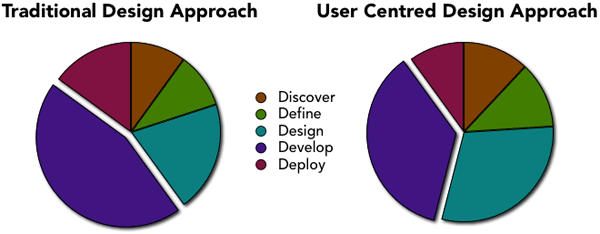
These charts show two ways of allocating time on a development project. Projects that use the traditional design approach need to allocate more time to development and deployment, since unforeseen problems will arise. In contrast, user centred design projects allocate more time to the early design phases, which means the project needs less time to fix usability problems later in the lifecycle. The amount of time spent on the project is the same with both design approaches.
Because user centred design has ramifications throughout the organisation, you'll need board level support to implement such a fundamental change. Identify someone at this level in your company who is a clear customer advocate. If no-one springs to mind, seek out a manager who is leading a customer-centred initiative like quality, six-sigma or business excellence and demonstrate how usability supports this initiative. Be prepared to challenge assumptions. Senior managers will assume that all your company's new products and services are tested with consumers – especially if they have seen the usability lab. Once you identify your advocate, here are some ideas that we've seen persuade managers that you can help them achieve their political ambitions:
Organisational change is most effective when you empower other people to implement it. Some ideas we have seen work include:
Another reason those cost benefit arguments don't always work is because they aren't based on data from your company or industry. For real impact, collect "before" and "after" ROI data to show the demonstrable benefits of your involvement. For example, estimate the likely savings during development, sales, use and support. Set this against the costs of your involvement to show that usability doesn't cost — it pays.
If you need to estimate any parameters, err on the conservative side. And be sure to phrase your findings in the language of business, not research. (Clue: The language of business usually starts with a currency sign.) For example, don't just talk about the number of successful participants in your test. Relate this to key business metrics like conversion rate and reduced support. With our e-commerce customers, we educate them about the "domino effect": usability problems early in the process erode the customer base, leaving fewer customers to enter subsequent phases. For a complex e-commerce transaction, it's not unusual for this effect to reduce sales by 50%-75%.
When you have ROI data, remember that usability goals are business goals. So use the numbers to define targets (KPIs or usability metrics) and get project managers to sign up to them.
There is a simple way to present usability data that, under the right circumstances, can make it irresistible and compels people to action. All you have to do is find it. In some organisations, this may be a detailed, analytical report that carefully weighs the costs and benefits of fixing each usability problem. For other organisations, it might be a PowerPoint presentation, summarising the key findings. Senior managers often get engaged when you show a highlights video, and Morae is truly a superb application for rapidly putting these types of presentations together. But you may need to get creative. In one organisation, the most powerful tool we observed was when they moved from standard reports to a highly visual, one-page "usability dashboard". These reports spread through the organisation quicker than an e-mail virus. If you were going to summarise the results of your 3-day usability test on just one page, what would you put in it?

Dr. David Travis (@userfocus on Twitter) is a User Experience Strategist. He has worked in the fields of human factors, usability and user experience since 1989 and has published two books on usability. David helps both large firms and start ups connect with their customers and bring business ideas to market. If you like his articles, why not join the thousands of other people taking his free online user experience course?

Gain hands-on practice in all the key areas of UX while you prepare for the BCS Foundation Certificate in User Experience. More details

Before you can implement a usability initiative in your organisation, you'll need to convince your manager it's worthwhile. The obvious approach is to use a cost-benefit argument, but experience shows that this approach often fails because many managers find the data unconvincing. An alternative approach is to tailor your argument based on your manager's MBTI personality type. Selling usability to your manager.

This article is tagged careers, strategy, roi, selling usability.
Our most recent videos
Our most recent articles
Let us help you create great customer experiences.
We run regular training courses in usability and UX.
Join our community of UX professionals who get their user experience training from Userfocus. See our curriculum.
copyright © Userfocus 2021.
Dr. David Travis (@userfocus) has been carrying out ethnographic field research and running product usability tests since 1989. He has published three books on user experience including Think Like a UX Researcher.
Get hands-on practice in all the key areas of UX and prepare for the BCS Foundation Certificate.
We can tailor our user research and design courses to address the specific issues facing your development team.
Users don't always know what they want and their opinions can be unreliable — so we help you get behind your users' behaviour.